AI agent vs answering service for dental clinics
Most practices compare phone-only services. The real comparison: AI agent across every channel vs a stack of single-purpose tools.
Your answering service costs $250/month and books zero patients
That sentence reads like an exaggeration. It isn't. A traditional answering service is a phone-only product designed to take messages — not to book appointments. The patient who called at 8pm with a chipped tooth hangs up with "we'll have someone call you tomorrow." By tomorrow they're at the urgent dental clinic three miles away.
Most practice owners who reach out to us start with the same question: "How does your service compare to our answering service?" That framing is already off, because an answering service is one tool trying to plug one of many holes in a small practice's communication stack.
What a modern dental practice actually needs to compare is a fragmented stack of single-purpose tools vs one AI agent that handles everything from the same brain.
Here's that fragmented stack, the way it usually looks:
A human answering service for after-hours calls — $150–$400/mo
Calendly or Square Appointments for online bookings — $20–$50/mo
A separate SMS reminder tool (Mango Voice, Weave, etc.) — $80–$200/mo
Stripe for deposits — free + transaction fees
A bilingual receptionist hire OR a separate Spanish-language line — premium of $400–$1,200/mo
A web chat widget (Tidio, Intercom) — $40–$100/mo
A WhatsApp Business setup that nobody actively watches — free but unmanaged
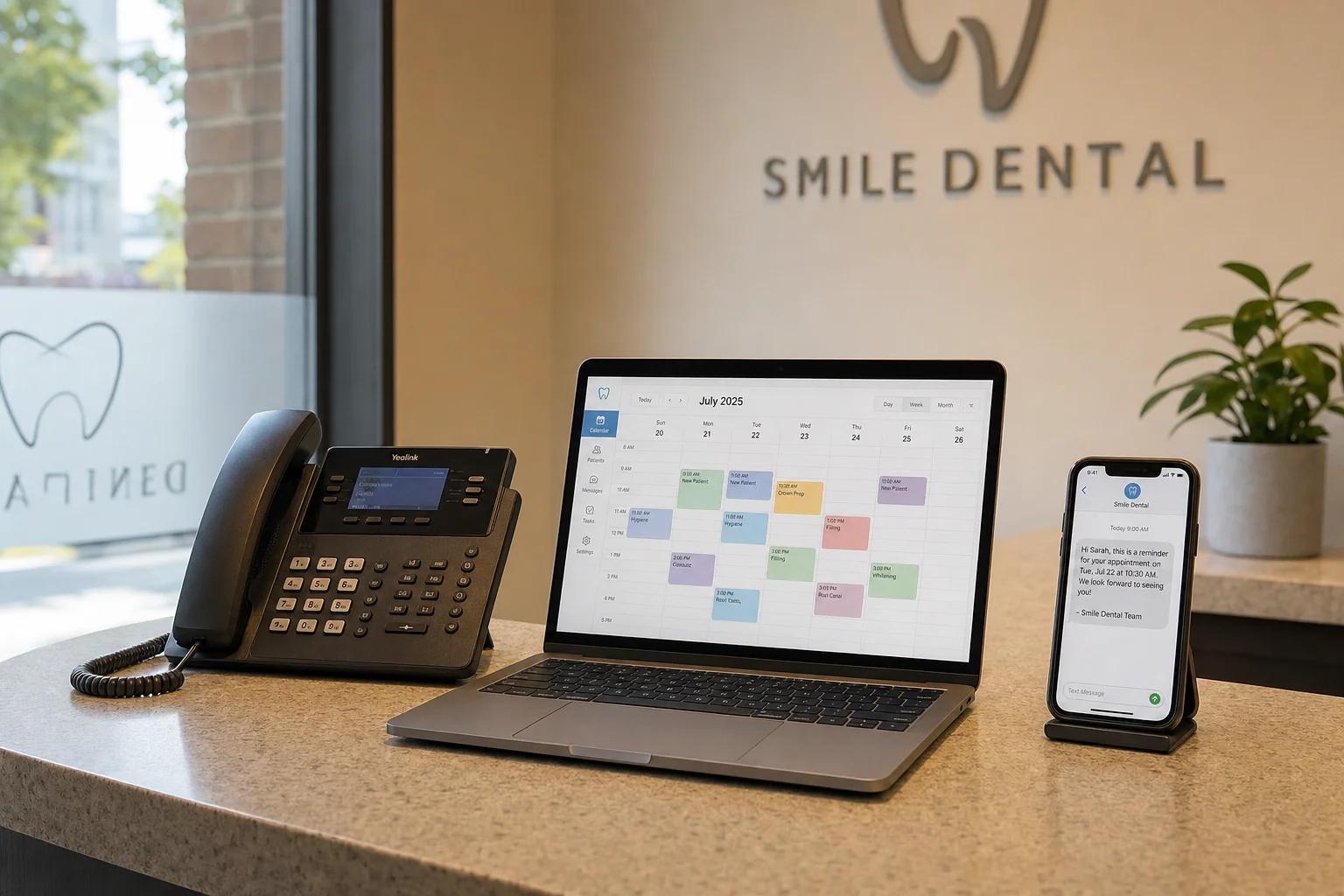
That's $700–$1,950/mo for tools that don't talk to each other. Your front desk re-enters appointments between Calendly and your dental software. Your answering service has no idea what's on your calendar. The reminder tool sends a text that has nothing to do with the deposit your patient was supposed to pay.
What an AI agent collapses into one brain
An AI agent like Sarase is one piece of software that:
Picks up the phone, runs full conversations (book, reschedule, cancel, triage emergencies, transfer to the on-call dentist).
Answers SMS — bidirectional, conversational. Patient texts "Can I move my Thursday cleaning to next week?" and the AI moves it.
Answers WhatsApp with the same brain. Critical for Spanish-speaking patient populations.
Handles the web chat widget embedded on your site. New-patient questions like "do you take Cigna?" get instant answers.
Sends deposit links via SMS for high-value services (root canals, whitening, consultations) — money goes straight to your Stripe Connect account.
Sends automated reminders via SMS before appointments.
Syncs to Google Calendar in both directions.
Operates in English and Spanish, switching mid-call or mid-text.
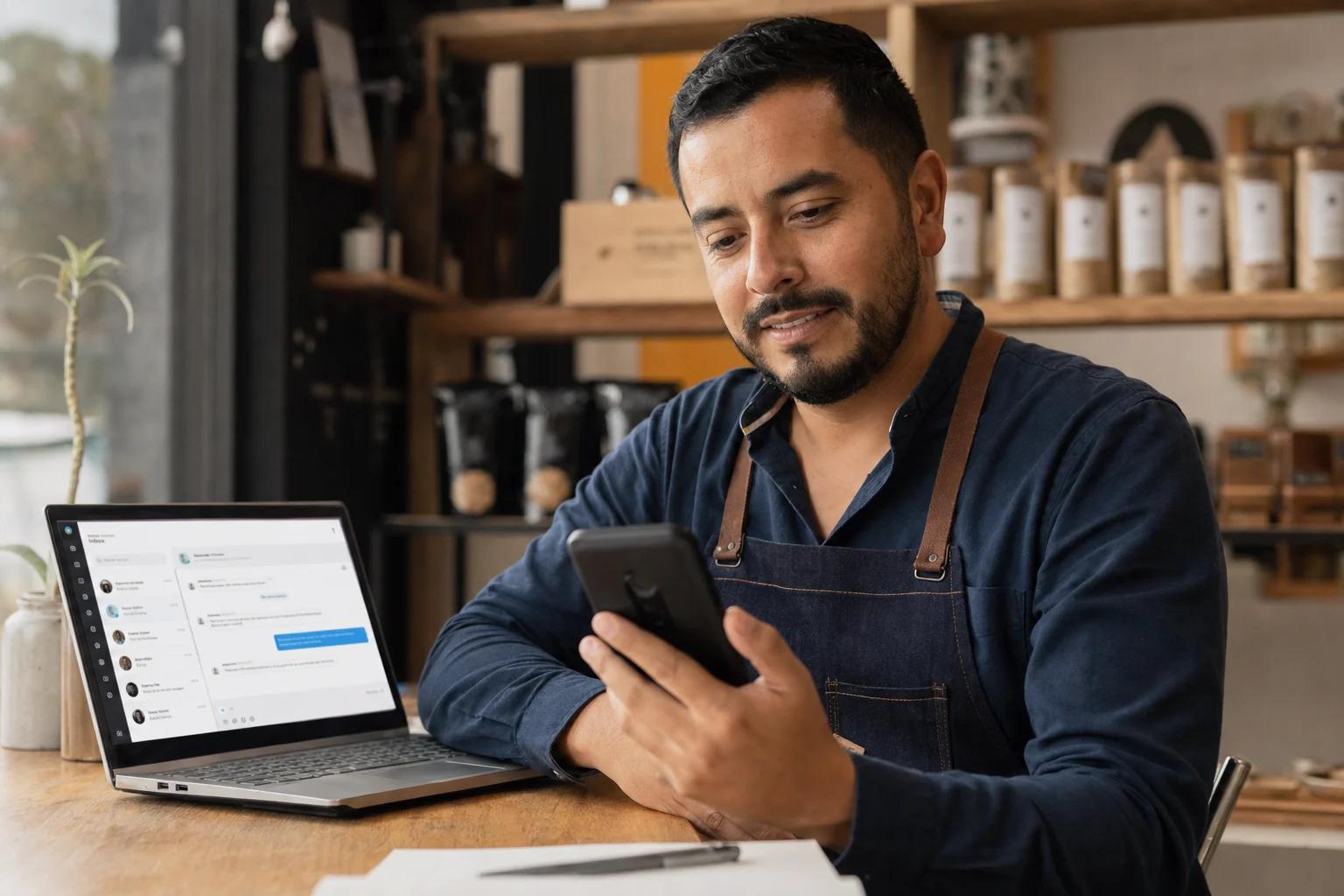
Lives in one unified dashboard where you see every conversation — voice transcript, SMS thread, web chat — in chronological order per patient.
Lets you take over any conversation by tapping "I'll handle this" — the AI steps aside, you reply yourself, and you hand it back when done.
That's not a comparison with an answering service. That's a comparison with five separate tools, glued together by your office manager's patience.
How the patient actually experiences each one
Fragmented stack
Patient calls at 8pm with a chipped tooth. Hits answering service.
"Thank you for calling Bright Smiles Dental, this is Jennifer with our answering service. I'll need to take a message and have someone get back to you tomorrow morning."
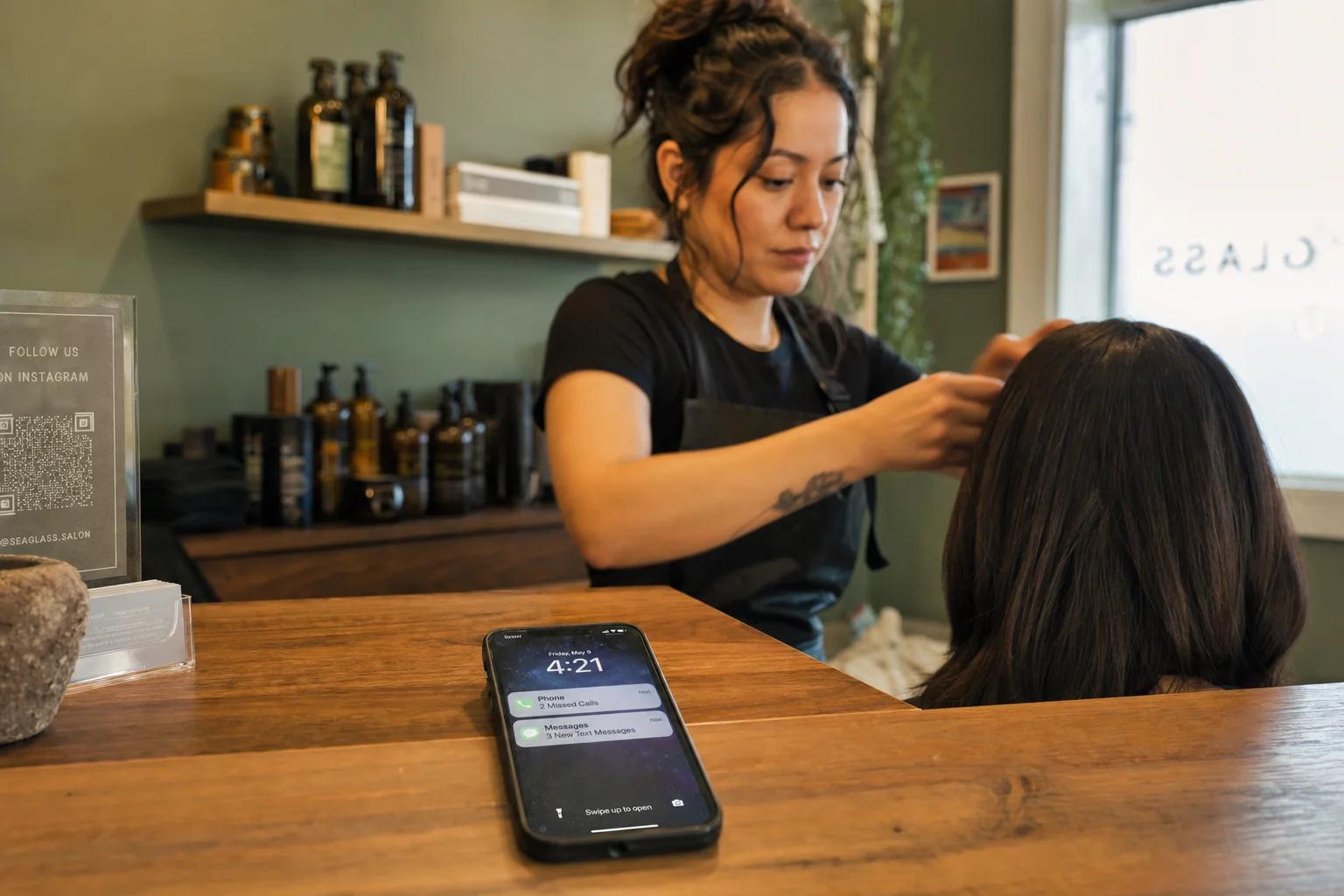
Same patient texts your published number at 9pm: "Hi do you have anything tomorrow?" — no reply, your team isn't watching the SMS line after hours.
Same patient WhatsApps the number on your Instagram bio at 9:15pm: "¿Atienden emergencias?" — no reply, nobody handles WhatsApp at all.
By the time you call back the next morning, the patient is at the urgent dental clinic three miles away.
AI agent
Patient calls at 8pm. AI picks up. Asks two triage questions, books an emergency slot at 8:30am with Dr. Chen, sends address via SMS, holds the slot pending text confirmation.
Patient SMSes the published number at 9pm asking for something tomorrow. AI checks calendar, offers two options. Patient picks one. Done.
Patient WhatsApps in Spanish. AI replies in Spanish. Books. Confirms.
The patient picks whichever channel they're already in, gets a booking inside 90 seconds, and the practice never had to "call them back."
Cost comparison, honestly
For a typical small dental practice (3 dentists, ~100 calls/week, after-hours coverage, bilingual patient base):
| Item | Fragmented Stack | AI Agent (Sarase Pro) |
|---|---|---|
| After-hours phone | $150–$400/mo | included |
| Online booking system | $20–$50/mo | included |
| SMS reminders | $80–$200/mo | included |
| Web chat widget | $40–$100/mo | included |
| WhatsApp handling | $0 (manual) | included |
| Bilingual coverage | $400–$1,200/mo | included |
| Deposit collection (Stripe Connect) | + setup time | included |
| Unified inbox | does not exist | included |
| Total | $700–$1,950/mo | $399/mo flat |
Even before you count the time your front desk spends switching between tools, the math is settled.
Conversion is where the answering service really loses
The hidden cost of an answering service is conversion. When the operator takes a message, you call back the next day. From operator-level studies and our own customer interviews, the new-patient callback math typically looks like:
~40% never pick up the callback.
~25% have already booked with a competitor.
~10% decided to "wait and see."
That leaves about 25% of after-hours callers who actually become booked patients. With an AI agent that books in the moment — and on whichever channel the patient picked — conversion typically lands at 65–80%.
For a clinic where a new patient is worth $1,500–$3,000 over the first year, the difference between 25% and 70% conversion is the difference between a marketing budget paying for itself or not.
When the fragmented stack is still the right call
Be honest about your situation. Stick with a multi-tool setup if:
You require licensed dental assistants to triage clinically. A few specialty services contract with operators staffed by dental professionals who can give actual clinical guidance. AI cannot and should not do that — Sarase routes emergencies to your on-call line.
You have a HIPAA configuration audited for years that you don't want to disturb. Switching means re-validating your Business Associate Agreement. Sarase signs BAAs, but factor in the migration cost.
Your patient demographic specifically dislikes automated voice systems. A few practices serving 70+ populations find the friction not worth the savings.
How to decide in one afternoon
List every tool you currently pay for that touches patient communication. Add the monthly costs.
Pull your call log AND your SMS log AND your front-desk staff time. Estimate hours per week spent switching between tools.
Ask your current answering service for their booking rate. They won't have one — that's the point.
Estimate the lifetime value of a new patient at your practice.
If your stack costs more than $399/month, OR if your conversion rate on after-hours inquiries is below 50%, the decision is made.
Try Sarase free for 14 days. The dental clinic template includes cleanings, fillings, whitening, emergency triage, and bilingual setup out of the box. It can run alongside your current answering service so you can compare conversion side-by-side. See it for dental clinics specifically.
Frequently asked questions
- Is Sarase HIPAA-aware?
- Yes. Sarase signs Business Associate Agreements, encrypts data at rest and in transit, and limits access on a need-to-know basis. We're not a substitute for your overall compliance program — you still own that — but we're built to fit inside it.
- What happens with after-hours emergencies?
- The AI runs basic triage questions (pain level, bleeding, swelling) and either books the next available emergency slot or routes the call to your on-call dentist's line. You decide the triage rules during setup.
- Can my front desk still take calls when they want to?
- Yes. Calls ring through to your team during configured hours; the AI catches anything that goes unanswered after a set number of rings. Your team can also take over any SMS or chat thread mid-conversation.
- Will the AI know my insurance acceptance?
- You set it up once — accepted carriers, in-network rules, what to tell out-of-network patients. The AI uses your script. It won't invent policies or quote prices you haven't given it.
Sources
Sarase builds the AI agent for service businesses - one platform for voice, SMS, WhatsApp, web chat, deposits, and CRM. The articles here are written by the team that ships it.
About Sarase